
Passive House Mixed-Use Development – Boston, MA
Project Information
This five-story building (approximately 35,000 sq. ft.) is designed following Passive House program requirements. This mixed-use development includes commercial spaces such as retail and a business center, along with residential amenities including a gym and shared business areas. The ground level features high-end duplex apartments, while the upper floors consist of studio to three-bedroom residential units. Vertical circulation is supported by two staircases and one elevator.
The project integrates advanced all electric energy-efficient HVAC and ventilation systems, electric domestic hot water systems, smart building controls, rooftop solar panels and energy-efficient site lighting. These features enhance occupant safety while delivering a future-ready, low-carbon building with superior comfort and reduced operating costs. The building also includes open parking at the rear with EV charging provisions.
It stands as a strong example of a low-carbon, high-efficiency development that balances high efficiency design, reduced operational costs while a construction cost-conscious overall design approach.
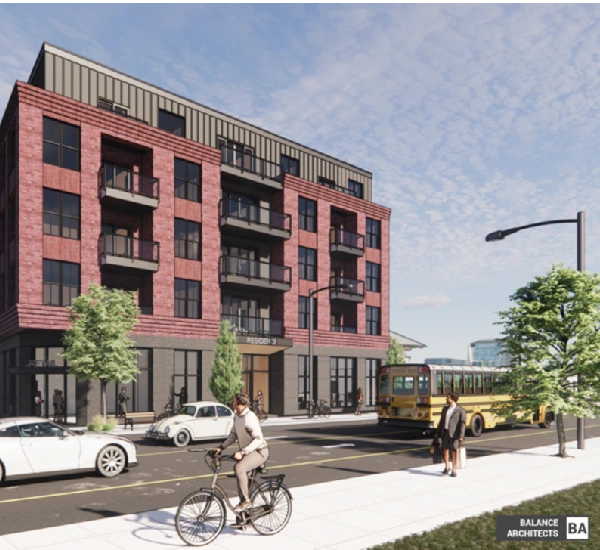
Project Visualization / Exterior View
What is MEP/FP Consultant Role in Passive House Project
Passive House design is not limited to high-performance building envelopes or insulation alone. At SAI, we understand that achieving true efficiency also requires optimized MEP system design. Building envelope performance and MEP efficiency must work hand in hand.
While high-quality insulation, airtight construction, and premium windows can significantly increase construction costs, integrating advanced HVAC technologies and energy recovery systems allows for greater flexibility. This approach enables cost optimization by reducing dependency on expensive envelope materials while still achieving high energy performance thru building mechanical system.
Our team collaborated closely with the Passive House consultant and architect to improve the energy model’s compliance margin. By continuously comparing modeled performance against target benchmarks, we identified opportunities to enhance overall MEP system performance. As MEP consultants, we evaluated and selected best MEP system solutions that achieved overall performance goal while maintaining overall project construction budget criteria.
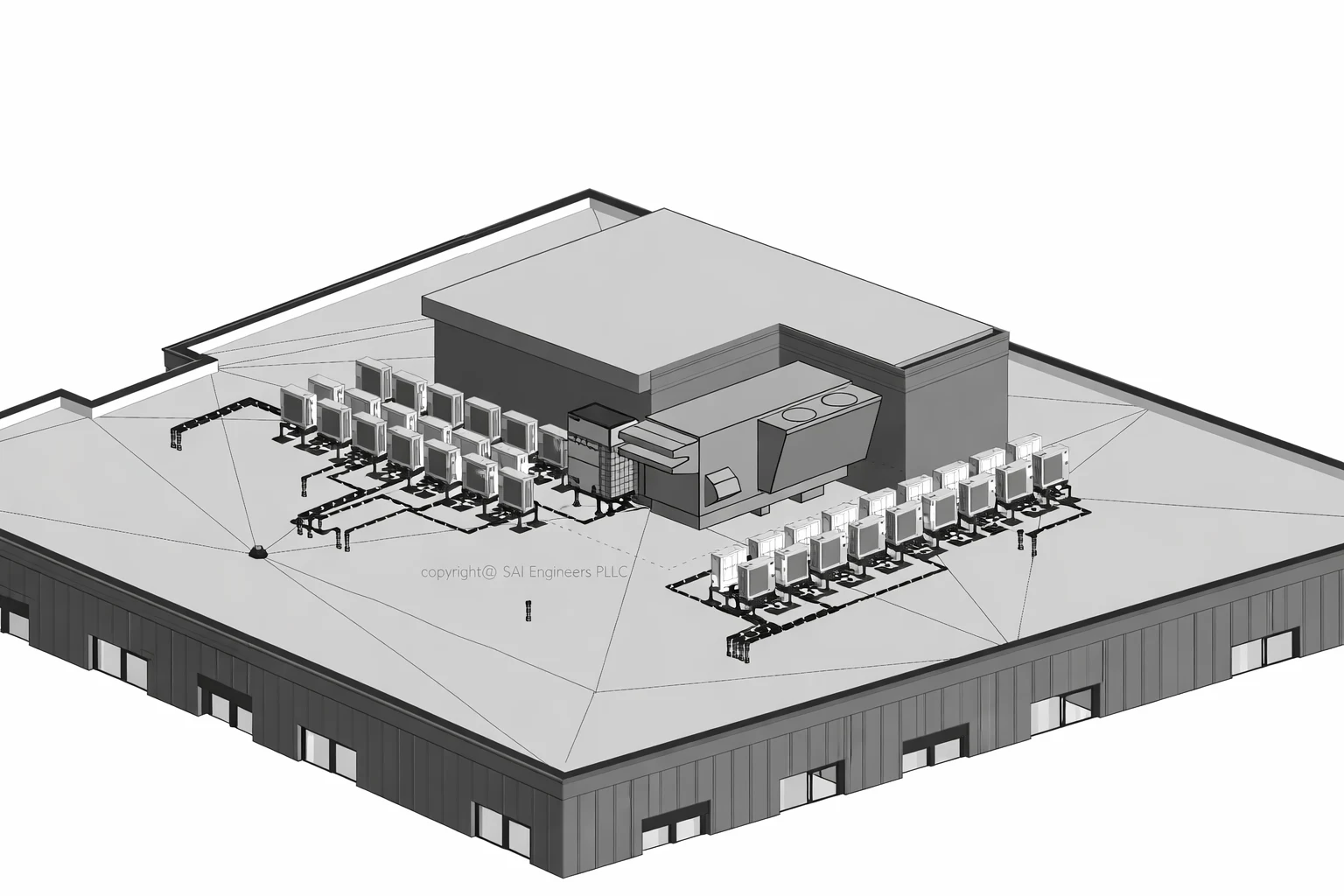
MEP System Layout / Rooftop Equipment Visualization
Beyond technical expertise, our role extended into active collaboration with all project stakeholders. SAI worked as an integrated team with architects, developers, and consultants to ensure coordinated and efficient design outcomes.
We utilized advanced visualization and rendering tools (such as Autodesk revit) to model critical areas such as the mechanical rooftop. These visualizations provided clarity on equipment layout, their accessibility, and multi discipline coordination. This enabled architects to design appropriate screening elements and to better understand system placement without compromising the building’s aesthetic appearance from the street.
Through this collaborative and technology-driven approach, the project successfully balances performance, cost, and design—delivering a high-efficiency Passive House development aligned with Boston’s sustainability goals.