
How Energy Modeling Helps Your Project
Energy Modeling | Investment vs Annual Saving | Improve MEP System Performance
When anyone considers adding a service beyond what is required by the city or necessary for construction, the first question that comes to mind is: How much will it cost?
In many cases, the upfront cost becomes the primary decision-making factor when evaluating whether that service is required or not. However, what often gets overlooked is the long-term value that such services bring to a project. The discussion is usually focused on initial upfront cost, but rarely on the value brings it to the project.
This is where energy modeling plays a critical role.
Energy modeling is one of the services we offer at SAI Engineers.
While it is not always required for permitting or construction, the value it brings to a project cannot be overlooked. Our approach is not limited to evaluating annual energy performance of a building. We take it a step further by incorporating all aspects of building operation, including lighting systems, HVAC systems, and even renewable energy sources such as solar panels or wind turbines. Each component is carefully analyzed based on actual building operation, ensuring that every system is accounted for in the overall performance.
One of the most important advantages of energy modeling is its ability to clearly demonstrate the relationship between investment vs annual saving. Instead of making decisions based only on upfront cost, clients are able to see how their investment impacts long-term utility bills, system sizing, and overall efficiency. This allows for a much more informed decision-making process, where both capital cost and operational savings are evaluated together.
Are You Comparing Multiple Design Options Before Making a Major Investment?
Our energy modeling process also helps project teams explore multiple design approaches. For example, we analyze different building envelope options such as insulation levels, wall materials, and glass specifications. We can even evaluate the impact of overall glass percentage in the building design. These comparisons provide a clear understanding of how design choices affect HVAC sizing, annual energy consumption, and system efficiency. The final energy report gives a detailed comparison of different design scenarios, helping clients understand how each option influences both cost and performance.
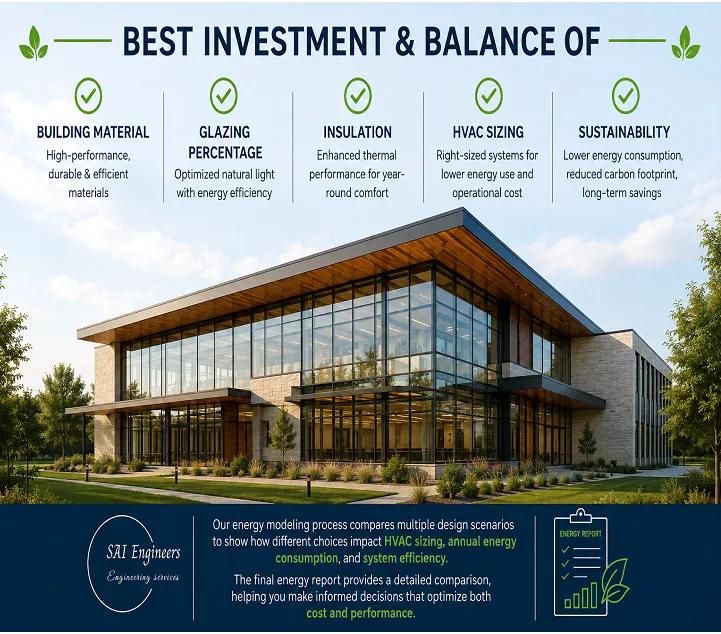
Are You Evaluating Whether Investing Beyond Code Minimum Improves Your Building's Performance?
In addition, SAI Engineers offers energy comparisons between code-minimum building envelope parameters and proposed architectural designs. This allows clients to clearly see whether additional investment in building materials leads to measurable improvements. The results often show a direct impact on reduced HVAC system size, lower annual energy consumption, and noticeable savings in utility costs. This is a practical way to evaluate whether the added upfront cost is justified by long-term benefits.

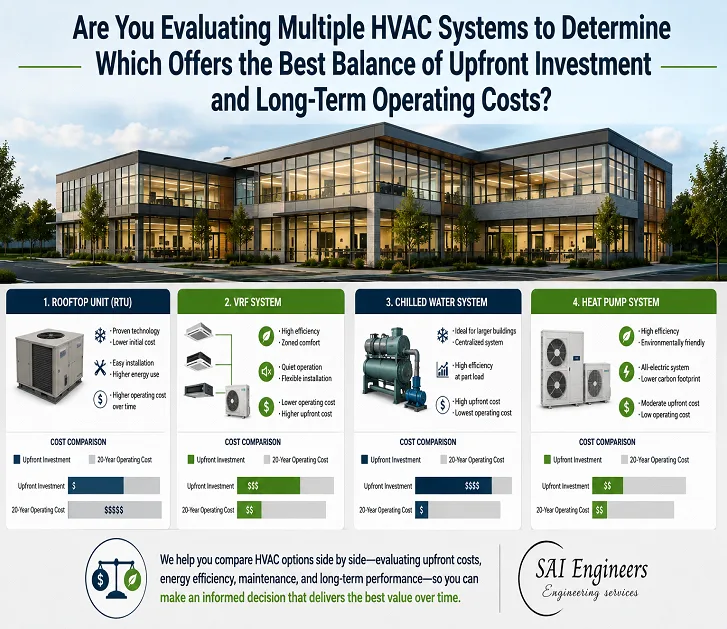
Are You Evaluating Multiple HVAC Systems to Determine Which Offers the Best Balance of Upfront Investment and Long-Term Operating Costs?
We also provide energy modeling comparisons between multiple HVAC system options for the same building design. This is especially useful when clients are deciding between systems such as natural gas heating and fully electric solutions. By comparing these options, we provide a clear picture of system costs, expected energy consumption, and monthly utility bills. This approach helps clients choose the most efficient system while also improving overall MEP system performance.
Ultimately, a relatively small additional investment in energy modeling, along with coordination between the architect and the SAI team, provides significant value. It gives clarity to the client’s vision, validates design decisions, and helps improve MEP system performance over the life of the building. The result is not just a compliant design, but a high-performing, efficient, and cost-effective building.
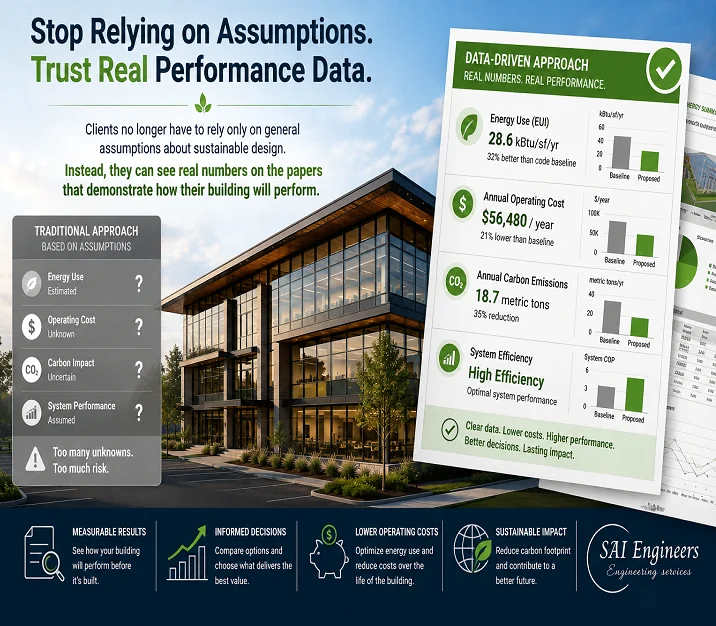
At SAI Engineers, we believe that energy modeling is not just an added service—it is a strategic tool that helps transform design decisions into measurable results.
Energy modeling is a simulation-based service that predicts how a building will perform in terms of energy use, HVAC sizing, lighting, and renewable systems like solar or wind. While it isn't always required for permitting, it helps building owners and architects make informed decisions by showing the real relationship between upfront investment and long-term operating costs.
Not always. Many jurisdictions, including Boston, don't mandate energy modeling for every project. However, SAI Engineers recommends it as a strategic tool because it validates design decisions, improves MEP system performance, and often uncovers savings that outweigh the modeling cost itself.
Energy modeling allows you to directly compare systems...such as natural gas heating versus fully electric HVAC - before committing to a design. SAI Engineers' reports show projected energy consumption, monthly utility costs, and system sizing for each option, so you can choose the system with the best long-term value, not just the lowest install cost.
Yes. Our energy modeling process evaluates envelope variables including insulation levels, wall assemblies, and glazing percentage. This shows how each choice affects HVAC sizing, annual energy use, and overall efficiency, so architects and owners can weigh design intent against performance and cost.
SAI Engineers runs comparative energy models between a code-minimum baseline design requirement and your actual proposed design. This highlights whether investing beyond code requirements produces measurable benefits, such as a smaller HVAC system, lower annual energy costs, and reduced utility bills over the building's life.
Our modeling approach goes beyond HVAC alone. We incorporate lighting systems, mechanical systems, and renewable energy sources like solar panels or wind turbines, architectural elements such as % of glass facade, insulation, building materials so the final report reflects how the building performs as a complete system rather than in isolated pieces.
Energy modeling represents a relatively small additional investment compared to overall project cost, but it often reveals savings in HVAC sizing, utility bills, and system efficiency that far outweigh that initial fee. It replaces guesswork with real, documented numbers for decision-making while considering multiple options for your project during initial phase..
All three. Architects get validation for design choices, owners get clarity on long-term operating costs and ROI, and contractors get more accurate system sizing before construction. It's a coordination tool that aligns the whole project team around performance goals.
Reach out to SAI Engineers with your architectural drawings or design intent, and our team will scope an energy modeling package tailored to your project - whether that's a single design comparison or a full envelope-vs-HVAC-vs-renewables analysis.